John 3:16 is one of the most quoted verses in Scripture. It is often treated as a self-contained summary of the gospel, a verse that needs no context.
But Jesus does not speak it in isolation. He grounds its meaning in an earlier biblical story, one marked by judgment, death, and unexpected healing. When John 3:16 is read through the lens Jesus Himself provides in John 3:14–15, the depth and shape of God’s love become clearer and more demanding than a sentimental reading allows.

John 3:16 in Its Immediate Context
John 3:16 reads:
“For God so loved the world that he gave his one and only Son, that whoever believes in him shall not perish but have eternal life.”
The verse declares love as motive, giving as action, and eternal life as outcome. But Jesus does not begin here. Immediately before this statement, He frames the kind of giving He means.
He says:
“Just as Moses lifted up the snake in the wilderness, so the Son of Man must be lifted up, that everyone who believes may have eternal life in him.” (John 3:14–15)
Before Jesus speaks about love, He speaks about being lifted up. Before He speaks about eternal life, He directs Nicodemus to a wilderness story marked by judgment, death, and unexpected healing. John 3:16 cannot be understood apart from John 3:14–15.
The Story Jesus Points To
The story Jesus invokes comes from Numbers 21:4–9.
Israel is obeying God by detouring around Edom, yet the road is long and discouraging. Scripture records:
“The people grew impatient on the way. They spoke against God and against Moses…” (Numbers 21:4–5)
Their complaint is not merely about discomfort. They despise the manna, the very provision God has given. Their speech becomes contemptuous toward God’s way of sustaining them.
The response is severe but precise:
“Then the LORD sent venomous snakes among them; they bit the people and many Israelites died.” (Numbers 21:6)
The judgment does not introduce death so much as expose it. Sin already carries death within it, and God allows the people to experience the seriousness of their rejection.
When the people repent, they say:
“We sinned when we spoke against the LORD and against you. Pray that the LORD will take the snakes away from us.” (Numbers 21:7)
God’s response is unexpected:
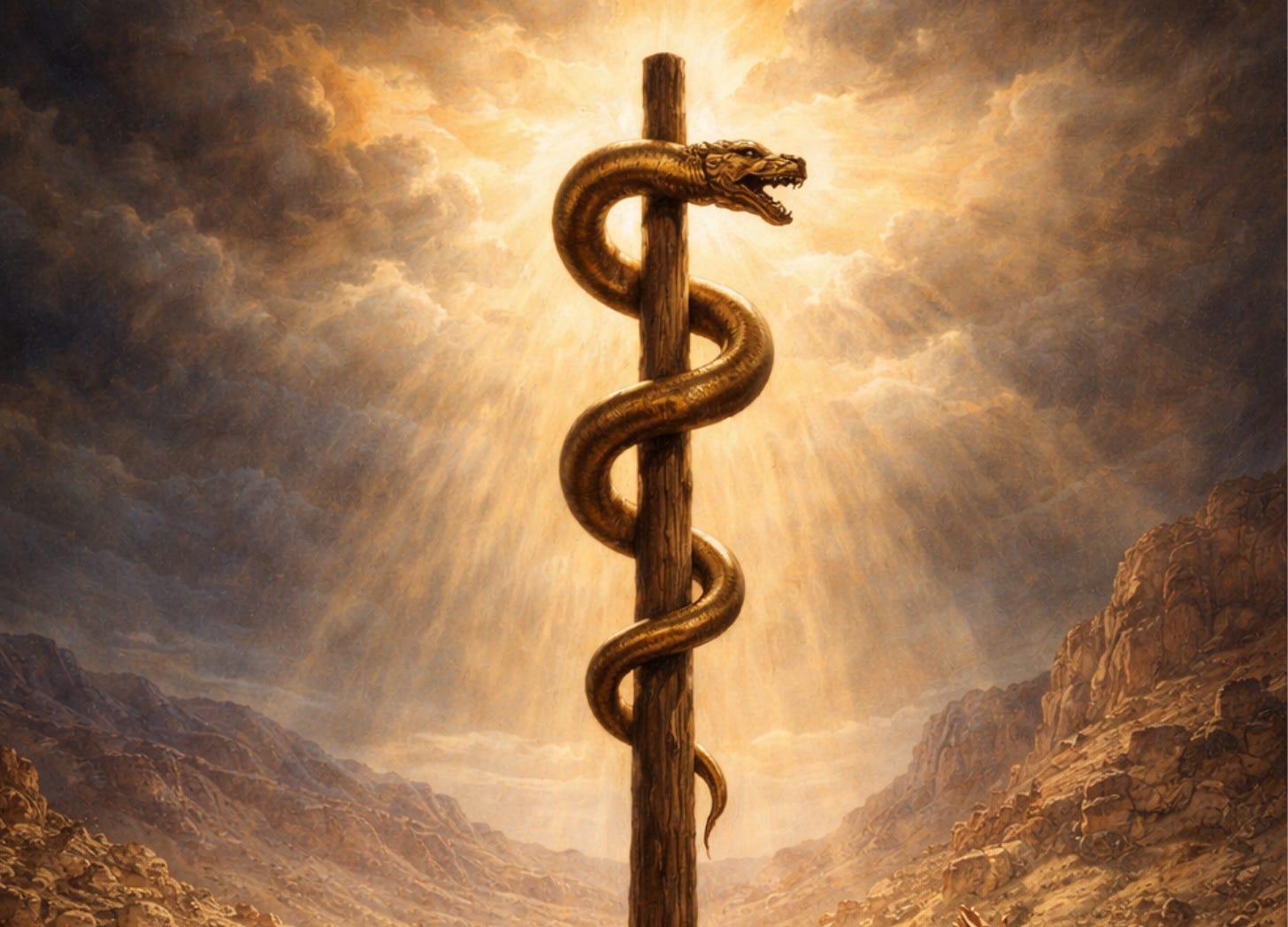
“Make a snake and put it up on a pole; anyone who is bitten can look at it and live.” (Numbers 21:8)
The snakes are not removed. The danger remains. Healing comes not by escape, but by looking in trust at what God has lifted up. The cure is not removal from the wilderness, but presence within it that overcomes death.
“Then when anyone was bitten by a snake and looked at the bronze snake, they lived.” (Numbers 21:9)
Jesus’ Interpretation
Jesus interprets this story.
“Just as Moses lifted up the snake in the wilderness, so the Son of Man must be lifted up.” (John 3:14)
The comparison is deliberate. In the wilderness, the symbol of judgment, the serpent, is lifted up so that those under judgment may live. The very thing that brought death becomes, in God’s hands, the means of healing. On the cross, Jesus is lifted up bearing the likeness of what destroys humanity, sin and death, though He Himself is without sin.
Later New Testament theology makes this explicit:
“God made him who had no sin to be sin for us, so that in him we might become the righteousness of God.” (2 Corinthians 5:21)
The cross functions the way the bronze serpent did. What brings death is confronted openly, not denied, and healing is offered through trust rather than self-rescue.
Hearing John 3:16 Again
With this background, John 3:16 takes on sharper definition.
“For God so loved the world that he gave his one and only Son…”
The giving is not abstract. It is the giving of the Son to be lifted up publicly, vulnerably, and shamefully. God’s love is expressed not by removing the wilderness or eliminating danger immediately, but by entering fully into humanity’s condition and dealing with it decisively. The cross does not bypass suffering. It meets it.
This does not mean suffering is good or desired, only that God does not wait for suffering to end before offering life.
The promise follows:
“…that whoever believes in him shall not perish but have eternal life.”
Belief here mirrors the act of looking in Numbers 21. It is not achievement, understanding, or moral repair. It is trust directed toward what God has lifted up for salvation.
Salvation in the Presence of Danger
Numbers 21 and John 3 together teach that salvation does not always mean immediate relief from suffering. In the wilderness, the people still felt the bite before they looked. Healing followed trust.
Likewise, coming to Christ does not guarantee the absence of pain, but the presence of a life that overcomes death. God’s love meets humanity in its brokenness, not after it has been repaired.
“While we were still sinners, Christ died for us.” (Romans 5:8)
The Pattern of God’s Love
God saves not by ignoring sin and death, but by lifting up a means of salvation within their reality. Life comes through looking, believing, and trusting what God has provided.
This is how God’s love works. Not by removing danger before healing is offered, but by entering the wilderness and lifting up salvation where wounded people can see it.
Conclusion
John 3:16 declares that God’s love gives life. John 3:14–15 reveals that this life comes through the Son being lifted up. Numbers 21 shows that God has always healed by inviting His people to trust what He raises before them rather than escape the wilderness altogether.
God so loved the world that He did not look away from death. He lifted salvation up where wounded people could see it.
And whoever looks to the Son who was lifted up will live.