

Seeing Before Following
Why God slows you down before leading you forward

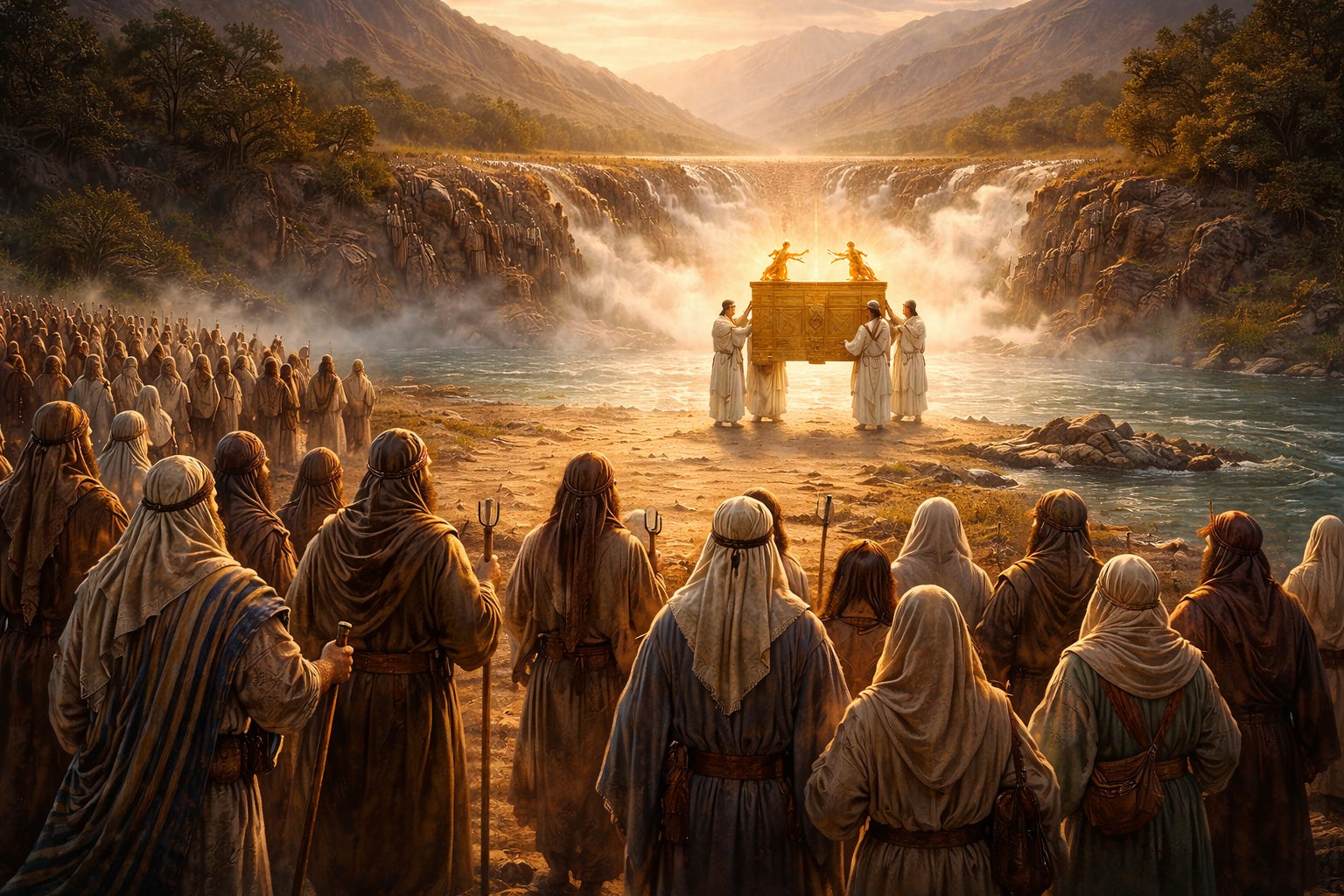
Joshua 3:4 contains a deceptively simple instruction that reveals a deeply consistent biblical pattern of guidance:
“But keep a distance of about two thousand cubits between yourselves and the ark. Do not go near it, so that you can see the way to go, for you have not traveled this way before.”
At the very moment Israel is about to step into promise, God does not urge them forward with speed or draw them closer for reassurance. He introduces distance.
This distance is not absence. It is structure.
Joshua 3:4 suggests that when God leads His people into unfamiliar territory, He often orders their movement in a recognizable pattern: seeing leads to knowing, and knowing stabilizes following. This is not a universal formula. Abraham followed God’s call into an unknown land before he could see where he was going. Peter stepped out of the boat with only partial understanding. Faith, as Hebrews 11 makes clear, regularly involves movement toward what is not yet seen.
But there are moments, particularly in corporate transitions into unfamiliar obedience, when God slows the pace and structures perception before He requires movement. Joshua 3 is one of those moments. And the pattern it reveals is worth sitting with carefully.

The Gap Is Not Absence
The reason for distance in Joshua 3:4 is explicit: visibility.
“So that you can see the way to go.”
God wants the entire community oriented by His movement, not by leaders alone, not by crowd momentum, not by instinct. The space ensures that no one follows blindly and no subgroup controls direction.
This matters because Israel has never entered promise this way before. There are no inherited maps, no precedents, no marked paths. The way forward will be revealed only as God moves. And if the people cannot see Him move, they will default to assumption, anxiety, or the loudest voice in the crowd.
God refuses to let that happen. He builds clarity into the structure of their obedience before they take a single step.
Throughout Scripture, God establishes sight before action in different ways and for different purposes. Moses sees the burning bush before receiving his commission, a theophany that reorients everything he thought he knew about who he was and who God is. Isaiah sees the Lord high and lifted up before understanding his calling, a visionary encounter that breaks him before it sends him. The disciples follow Jesus through three years of daily formation, watching before they are sent. These are qualitatively different kinds of seeing: theophany, prophetic vision, relational formation. What Joshua 3 adds is a fourth category, directional and communal, in which an entire people is positioned to see the same movement of God at the same moment. In each case, God anchors obedience in some form of perception before He requires action.
Seeing grounds obedience in reality rather than impulse.
When Seeing Becomes Conviction
In Scripture, knowing is rarely abstract. It is not mere information. It is relational certainty formed through encounter.
Joshua 3 assumes this progression. Once the people see the ark move and the waters respond, they will know where God is leading and who is with them. This knowing is not produced by explanation. It is formed by witnessed faithfulness.
The same pattern appears just one chapter earlier with Rahab. “I know that the Lord has given you this land,” she declares in Joshua 2:9. Her knowing does not come from instruction but from observation. She has watched God’s actions echo through history and drawn the correct conclusion. Vision produced conviction.
When knowing is grounded in seeing, obedience becomes durable. When it is not, belief remains fragile and easily shaken.
Movement That Doesn't Need Pressure
Only after seeing and knowing does Joshua 3 call the people to follow.
The people are not permitted to surge ahead or crowd the ark. They must wait, watch, and then move together.
This ordering directly addresses the failure of the previous generation. In Numbers 13, Israel acted without clarity. They followed fear rather than vision, interpretation rather than alignment. Ten spies saw the same landscape Caleb and Joshua saw, but they did not see God’s presence in it. Their vision stopped at obstacles. And because their seeing was partial, their knowing became distorted, and their following turned to rebellion.
Joshua 3 teaches a different posture.
The people follow not because they are pressured, energized, or afraid of missing God, but because direction has become unmistakable. They have seen the ark. They will see the waters part. And that seeing will settle into a knowing that makes following possible.
Obedience that grows out of clarity does not require constant reinforcement. It does not depend on emotional intensity. It carries weight without frenzy.
When Distance Is Preparation
Joshua 3:4 also corrects a common spiritual assumption: that intimacy always requires proximity.
Scripture suggests otherwise. At Sinai, God establishes boundaries not to withdraw but to protect His holiness from being reduced to control. In 2 Samuel 6, when Uzzah reaches out to steady the ark, the consequences are severe. What is at stake is not emotional familiarity alone, but disregard for God’s holiness expressed through disobedience to instruction. The ark was to be handled in prescribed ways for prescribed reasons. Treating those instructions casually, however well-intentioned, proved fatal. Presumed intimacy is not the same as reverent relationship.
In the New Testament, Jesus often creates distance to preserve clarity. He withdraws from crowds when their demands threaten to distort His mission. He tells Mary Magdalene not to cling to Him in John 20, not as rejection but as reorientation. Relationship is deepening, not diminishing.
Distance, when initiated by God, often signals transition into maturity. It is worth acknowledging that not all divine distance carries this meaning. Sometimes it reflects judgment. Sometimes hiddenness for testing, as in Job. Sometimes what feels like distance is a matter of human perception rather than actual withdrawal, as the psalms of lament make plain. These are real and distinct categories.
But in Joshua 3, the distance is clearly formational. The people are no longer infants being carried. They are a maturing community learning to walk in step with God’s presence rather than clinging to it in panic.
This is worth sitting with, because the experience of God-initiated quiet is one of the more disorienting features of maturing faith. When the felt nearness of earlier seasons gives way to something quieter and more spacious, the instinctive conclusion is that something has gone wrong. Prayer feels less vivid. The emotional warmth that once confirmed God’s presence is no longer reliably present.
Joshua 3:4 offers a different interpretation. What feels like withdrawal may be God positioning you to see more clearly. The two thousand cubits between Israel and the ark was not abandonment. It was the exact distance required for an entire community to see the same thing at the same time.
Seasons of felt distance may be precisely the seasons in which He is most carefully preparing you to see what He is doing next.
Before The Path Has A Name
The final clause of Joshua 3:4 explains everything: “You have not traveled this way before.”
When obedience is unfamiliar, God does not rely on instinct. He provides structure. He slows the pace. He clarifies vision. He ensures the people are oriented toward Him rather than toward one another.
The two thousand cubits creates the conditions needed for a whole community to see the same movement of God at the same time. Within this particular moment in Joshua 3, no one can substitute their interpretation for what God is making visible to all. The structure of visibility is itself a check on manipulation, presumption, and crowd-driven momentum.
God does not want His people guessing where He is going. He wants them watching.
And this reveals something about His character. He does not send His people into the unknown and then blame them for confusion. He orders their movement so that obedience becomes possible, not because they are exceptionally perceptive, but because He has made Himself visible.
What This Quietly Corrects
The pattern in Joshua 3 quietly confronts several distortions that still shape how we think about obedience.
Following without discernment assumes that movement is obedience. Scripture never celebrates motion for its own sake. It honors movement aligned with God’s direction, and alignment requires sight.
Equating proximity with intimacy assumes that closeness to God always feels close. Joshua 3:4 disrupts this. The distance God establishes is not rejection. It is the condition for perception.
Mistaking activity for obedience is subtle because busyness can feel like faithfulness, especially when motivated by spiritual urgency. Joshua 3 introduces waiting, watching, and structured movement. The people are not rewarded for getting to the river first.
Crowd-driven spirituality defaults to imitation when vision is unclear. People follow whoever seems most confident, most energized, most certain. The structure of Joshua 3 prevents this by ensuring the entire community sees the same thing at the same time.
Familiarity masquerading as faith treats God casually because He has been present before. But intimacy without reverence is presumption. The distance God establishes protects both His holiness and the people’s ability to recognize His presence as sacred, not routine.
Joshua 3:4 insists that true obedience is not blind. It is attentive.
God does not say, “Move quickly so you don’t miss Me.” He says, “See clearly so you can follow faithfully.”
One Thing, Clearly
Joshua 3:4 reveals that God often leads His people into promise by first ordering their perception. He invites them to see. Seeing forms knowing. Knowing makes faithful following possible.
Distance is not abandonment. It is guidance. And when obedience requires stepping into unfamiliar waters, clarity is not a luxury. It is the condition that makes this kind of corporate obedience possible, not forced.
The people standing at the edge of the Jordan do not yet know what the promised land will require of them. They do not know how many battles lie ahead, how many moments of fear they will have to overcome. But they do not need to know all of that yet.
They need to know one thing: where God is.
And God makes sure they can see.

A personal note:
This essay arrived in a season where the Lord felt unusually quiet.
Not absent. Quiet. Specifically quiet about the one thing I most wanted Him to address.
I had come from a season of unusual closeness, the kind where He seemed to speak into everything. Direction felt clear. His presence felt near. And then the silence landed on the exact subject I needed most: '“the promised land.” What it looked like. When it was coming. Whether it was still coming.
My instinct was to crowd in. To press harder in prayer. To demand clarity now because the waiting felt unbearable and the not-knowing felt like abandonment.
What I was learning, slowly, was that the distance was not withdrawal. It was positioning. He was not further away. He was making space for me to see clearly rather than crowd in and lose perspective.
Joshua 3:4 became less theoretical and more personal. The two thousand cubits were not punishment for impatience. They were the precise distance required for me to actually see what God was doing instead of projecting what I wanted Him to do.
Sometimes the silence on the specific thing is God ordering your obedience before you take a single step into unfamiliar territory. Sometimes what feels like distance is Him making sure you can see.
I did not find that comforting immediately. But I find it true.