In Numbers 15, God gives Israel a strange and tender instruction. He tells them to sew tassels onto the corners of their garments, with a single blue thread woven through.
The reason was not fashion or identity signaling. It was memory.
“When you see it, you will remember all the commandments of the Lord and do them.”
The tassel was meant to interrupt forgetfulness. It was a small, embodied reminder that life is lived before God, even in ordinary moments. Especially in ordinary moments.
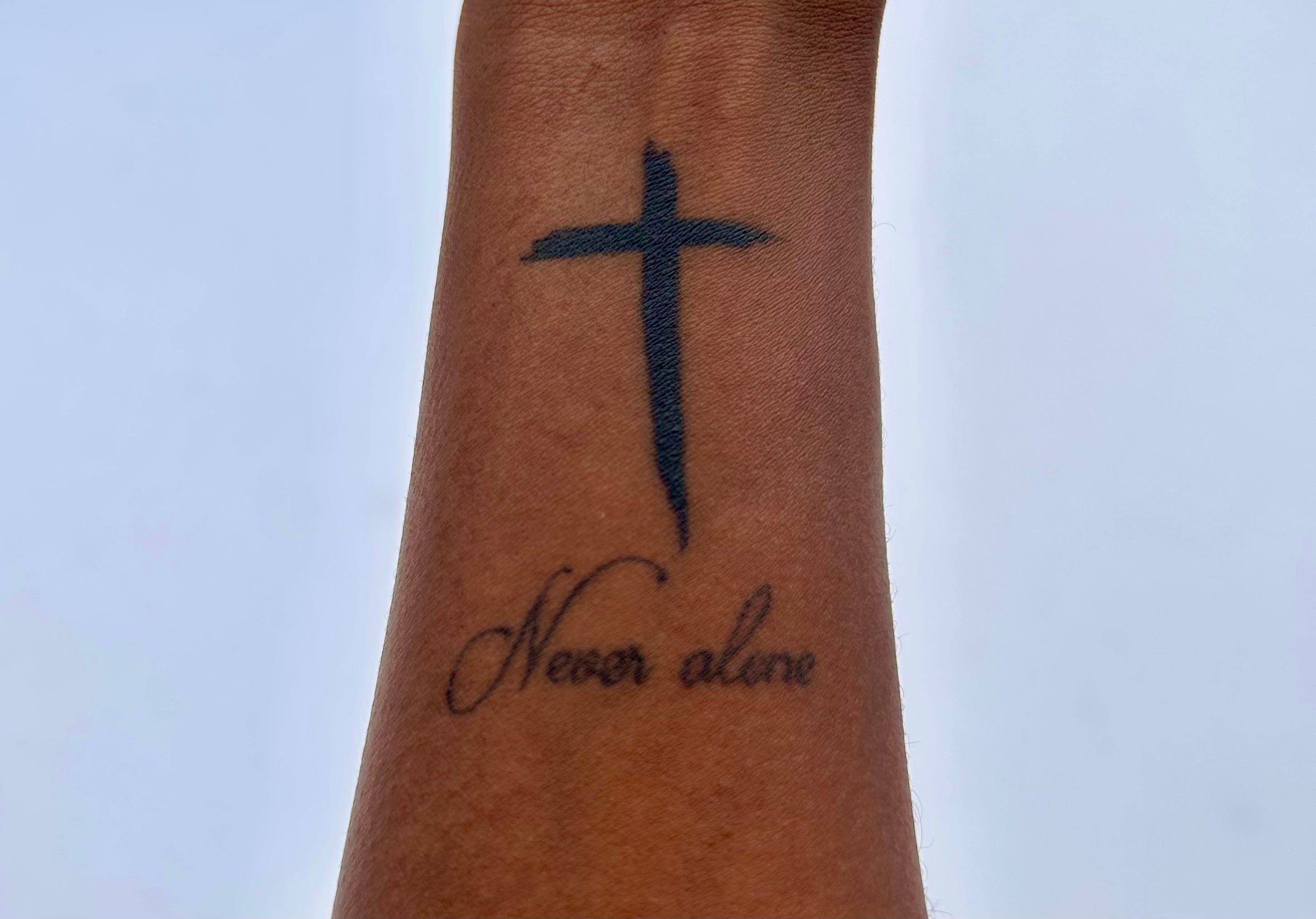
I carry my tassel on my right forearm.
It is a simple tattoo. A cross, with the words “Never alone” written beneath it. I did not choose it as a declaration of strength or a performance of piety. I chose it because I know how easily the wilderness convinces us that we are untethered.

God knows we forget
Numbers 15 comes on the heels of failure. This instruction follows a season of rebellion, after a generation learns they will not enter the land they were promised. It would have made sense for God to withdraw or to grow quiet in the face of their wandering.
Instead, He gives them a reminder.
Not a speech.
Not another warning.
Something they would see every time they moved their hands.
The tassel is mercy disguised as habit. God knows Israel’s weakness is not only defiance, but a profound spiritual amnesia. They forget who He is. They forget who they are. They forget that obedience flows from belonging, not fear.
The single blue thread, tekhelet, was associated with the heavens and with royalty. It was a silent whisper that even as homeless wanderers, they were a kingdom of priests.
So God gave them something visible to anchor their identity when their surroundings felt desolate.
Why the body matters
The tassel was worn, not stored. It brushed against the body as they walked. It showed up when they worked, rested, cooked, argued, and waited. It was not reserved for holy moments in the Tabernacle.
That is the genius of it.
God ties remembrance to the body because the body is where fear lives. It is where anxiety tightens the chest, where waiting stretches the nerves thin, where loneliness settles in the bones. Theology that stays only in the mind rarely survives a prolonged wilderness.
My tattoo lives on my right forearm for the same reason. In Hebrew thought, the right arm represents strength, action, and doing. By placing the reminder there, it intersects with my daily output. It shows up in motion. When I reach. When I carry. When I hold. When I brace myself.
It is not there to make me look spiritual to others. Jesus later warned against those who “make their tassels long” to be seen by men. This is not a billboard for the world. It is a compass for the wearer.
It reminds me that even in my doing, I am not self-carried.
“Never alone” is a confession
The blue thread in Israel’s tassel pointed upward, toward the throne of God. The cross on my arm points in three directions at once.
It points backward to an act of love already completed.
It points upward to a presence that does not withdraw when clarity is delayed.
It points inward, reminding me that the Spirit of the One who suffered is now the One who inhabits.
“Never alone” is not a slogan I repeat to convince myself. It is a confession of a truth I am prone to lose.
The wilderness lie is subtle. It whispers that waiting equals abandonment. That silence equals absence. That obedience must be endured in isolation.
The cross answers all three. It reminds me that God is often most present in the places where we feel most forsaken.
After failure, not after success
One of the most striking things about the tassel command is its timing. God gives it after judgment, not after triumph. After loss, not after victory.
It is as if God anticipates the question Israel will not ask out loud. Have we ruined everything. Are we still Yours.
The tassel answers quietly. You belong. Remember Me.
My tattoo does the same. It does not announce achievement. It anchors identity. It reminds me that belonging precedes obedience, and presence precedes progress.
It suggests that even when we have disqualified ourselves from the ideal path, God is still interested in the clothes we wear and the memories we keep.
A reminder that does not accuse
The tassel was never meant to shame Israel into obedience. It was meant to draw their eyes back when desire or despair pulled them elsewhere.
My forearm does not accuse me when I am tired or unsure. It does not demand a certainty I do not possess. It simply says, again and again, that I am not navigating this season alone.
It says that God has not stepped back.
That the cloud has not vanished.
That waiting is not the same thing as being forgotten.
The quiet mercy of embodied remembrance
God knows that faith lived only in ideas will thin under pressure. He knows our minds are fickle, but our bodies are present. So He gives reminders that can be seen, touched, and carried into the fray.
For Israel, it was a single thread of sky-blue woven into the hem of a dusty robe.
For me, it is ink etched into the skin of my reaching arm.
Both say the same thing.
You are not untethered.
You are not an orphan of the wilderness.
You are carrying a Presence that refused to leave you behind.
And sometimes, that is enough.
Enough to take the next breath.
Enough to take the next step.
Enough to believe that even here, you are home.